
On this page
Battery feedstock is bought and sold by the kilogram, so the weight of a lot is the number both sides care about most. In a well-run trade it is measured twice: once as the packs are collected, and again when the truck crosses the recycler's weighbridge. Reconciliation is the step that puts those two figures side by side and records the difference.
This piece explains where each weight comes from, what the law asks of the instruments, why the two never match exactly, and what to do when they differ. It describes how we reconcile lots, and what a recycler should expect from any supplier. It isn't legal or metrology advice.
What are the two weights?
Weight in is built from the bottom up. Every pack is stickered and weighed individually at pickup, and the reading is photographed. When packs are scanned into a lot and the lot is sealed, its weight in is the sum of those individual pack weights, and the lot manifest lists every sticker behind it.
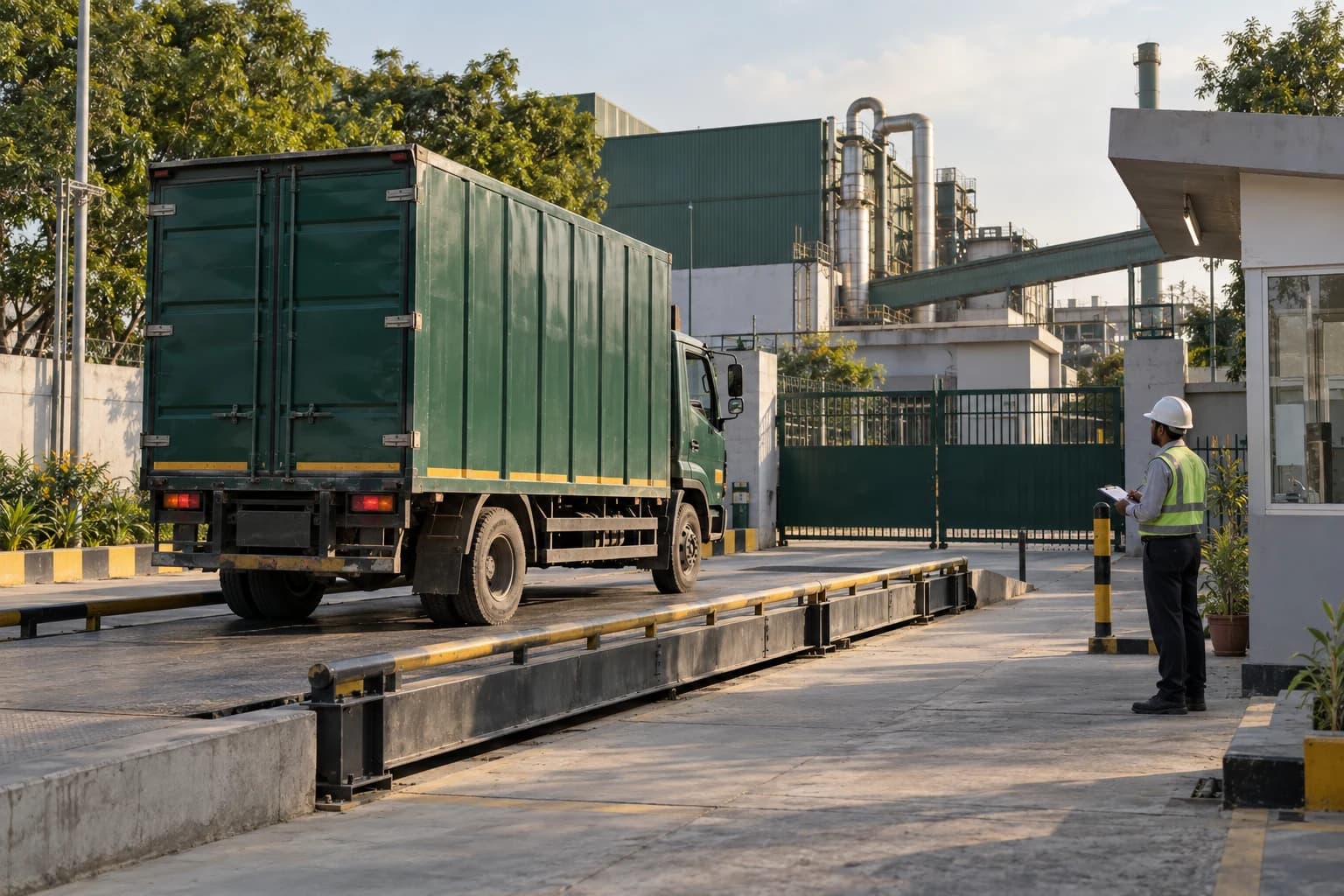
Weight at the gate is measured from the top down. At the recycler, the loaded truck crosses the weighbridge, unloads, and crosses again empty. The difference between the two readings is the net weight of what was delivered. That figure goes on the recycler's own slip, and it is the one the recycler's receipts and returns rest on.
Weighed at pickup
Each pack on its own, with a sticker number and a photo of the scale reading.
Sealed into a lot
Packs scanned in by sticker; weight in is the sum of their recorded weights.
Dispatched
With the lot manifest listing every sticker, the invoice, and an e-way bill where the consignment value requires one.
Weighed at the gate
Gross with the load, tare once empty; net is gross minus tare.
Reconciled
The gate weight is recorded against the weight in, and the variance is written down.
What does the law ask of a weighbridge?
A weighbridge used to buy or sell is regulated under the Legal Metrology Act, 2009. Section 24 requires anyone who uses a weight or measure in a transaction to have it verified before putting it into use, and the Act's definition of verification “also includes re-verification and calibration.” Verification of a road weighbridge is done by the state's Legal Metrology officers, who stamp the instrument when it passes, and it is re-verified periodically after that.
So the first question about any gate weight is a simple one: is the weighbridge verified, and is its stamp current? The same applies to the scales used at pickup.
Requires verification and stamping of weights and measures prior to their commercial use.
Why don't the two weights match?
Because no instrument is exact, and the law says by how much it may be wrong. OIML R 76, the international recommendation for non-automatic weighing instruments, sets maximum permissible errors in multiples of the instrument's verification scale interval, e: the smallest step it is verified to show. For a Class III instrument, the class used for most trade weighing, the allowance grows with the load.
Two more things widen the gap. In service, an instrument may err by “twice the maximum permissible errors on initial verification”. And a weighbridge's net weight comes from two weighings, gross and tare, each with its own allowance. Weight in has its own small errors too: it is the sum of many individual readings on a different scale.
Maximum permissible error on initial verification, Class III
In verification scale intervals (e), by load
| Up to 500 e | ± 0.5 e |
|---|---|
| 500 to 2,000 e | ± 1.0 e |
| 2,000 to 10,000 e | ± 1.5 e |
A worked example, with assumed figures
- Verification interval
- 10 kg (assumed)
- Gross weight, truck and load
- 14,000 kg = 1,400 e
- Allowance on initial verification
- ± 1.0 e = ± 10 kg
- Allowance in service
- ± 20 kg, on each of two weighings
- Sample variance
- −5.5 kg on a 6,214.0 kg lot (−0.09%)
What counts as an acceptable variance?
That is for the recycler and its supplier to agree, in writing, before the first lot. A feedstock specification should say whose weighbridge decides the invoiced weight, what tolerance applies, and what happens to a difference beyond it.
We agree a tolerance with each recycler. Every lot's variance is recorded exactly, as a signed figure, and never rounded away. A lot whose variance is beyond the agreed tolerance can't be closed as reconciled until someone has written down the reason. Only then does it move on to payment.
What explains a large variance?
Most large variances have ordinary causes: an unverified or drifting scale, a tare taken with something still on the truck, pallets and strapping counted on one side but not the other, or a pack that was left out of the load or added to it. The specification should settle how packing materials are treated, so both weights measure the same thing.
This is where pack-level records earn their keep. If every pack in the lot has its own sticker, weight and scale photo, a variance can be traced: the manifest can be checked against what was received, sticker by sticker, rather than argued over as a single number.
Questions to ask when a lot doesn't reconcile
- Is the weighbridge verified, and is its stamp current?
- Was the tare taken with the truck fully empty?
- Are pallets and strapping treated the same way on both sides?
- Does every sticker on the manifest match a pack received?
- Were the pickup scales verified, and do the scale photos match the recorded weights?
Why it matters beyond the invoice
Weight is the unit the battery regime runs on. CPCB's July 2026 guidelines on collection, handling, storage and transportation expect collection centres to weigh each delivery and keep the records, in kilograms, in the format of the hazardous waste rules. And under the Battery Waste Management Rules as amended in 2023, a recycler's EPR certificates are generated on “the weight of waste Battery processed or refurbished”.
So the weight a recycler records at its gate isn't only the basis for paying its supplier. It feeds the returns and certificates that producers rely on. A supplier whose weights reconcile, lot after lot, with an explanation for every exception, is making the recycler's records easier to stand behind. We cover what travels with each lot in the consignment record.
Collection centre should have weighing equipment for weighing each delivery received by it and maintain a record in this regard.
Frequently asked questions
- What is weighbridge reconciliation?
- Comparing the weight a lot was sealed at, the sum of its individually weighed packs, with the net weight recorded on the recycler's weighbridge, and writing down the difference.
- Does a weighbridge used in trade need to be verified in India?
- Yes. Section 24 of the Legal Metrology Act, 2009 requires a weight or measure used in a transaction to be verified before use, and verification includes re-verification. State Legal Metrology officers verify and stamp weighbridges.
- How accurate does a weighbridge have to be?
- OIML R 76 sets maximum permissible errors for non-automatic weighing instruments in multiples of the verification scale interval. For Class III, it is ±0.5, ±1.0 or ±1.5 intervals on initial verification depending on the load, and twice that in service.
- Whose weighbridge decides the invoiced weight?
- Whatever the recycler and supplier agree in writing before the first lot. The specification should also set the tolerance and what happens to a variance beyond it.
- What happens when a lot's variance is beyond the agreed tolerance?
- In our process, the lot can't be marked reconciled until the reason is written down. The pack-level records (stickers, weights and scale photos) are used to trace it.
We’d rather commit to a number we can hit than a number that sounds good.