
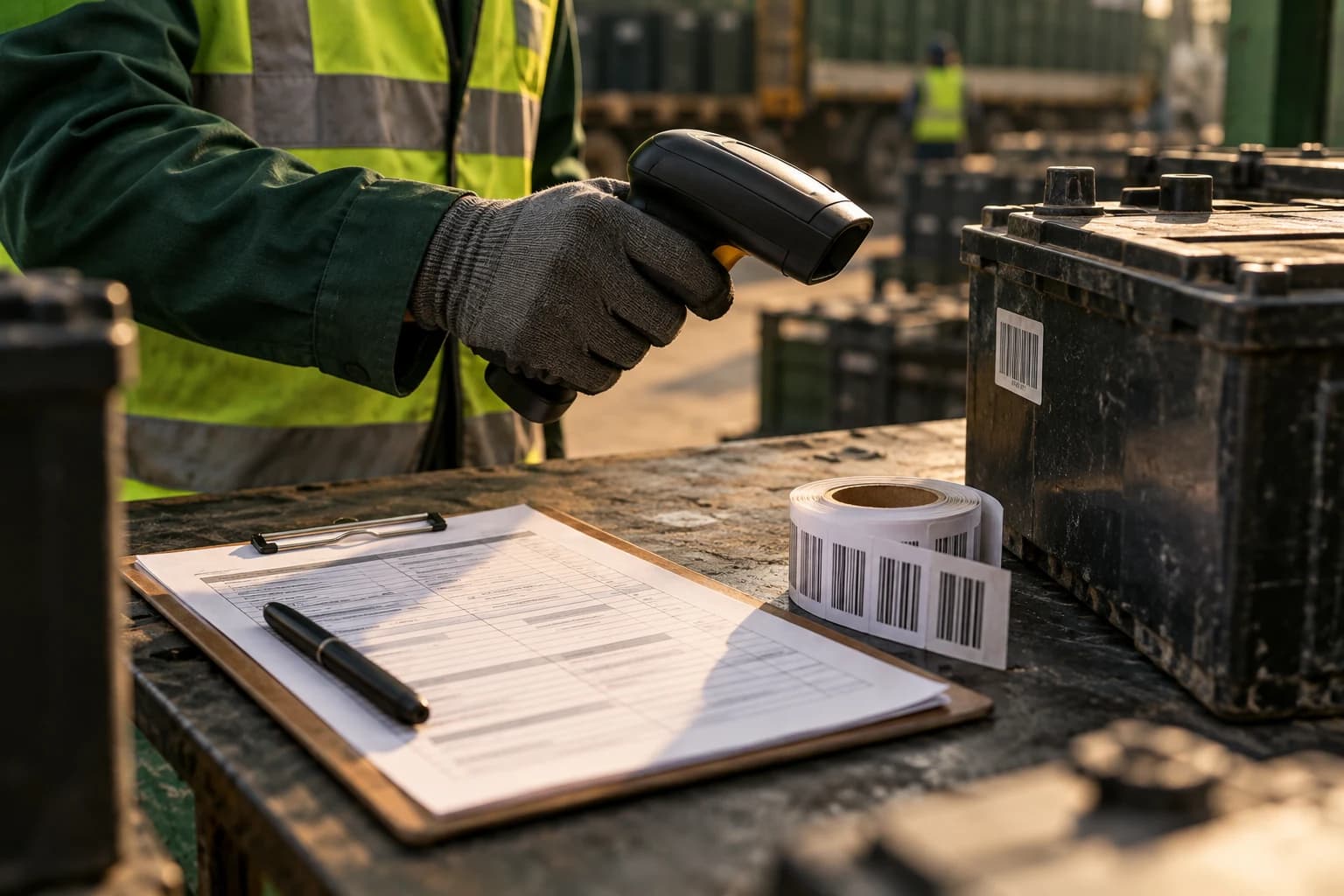
A used battery changes hands several times between the vehicle and the recycler: owner to dealer, dealer to collector, collector to yard, yard to truck, truck to recycler's gate. In the informal trade, each of those handovers erases its history. By the time a battery reaches a plant, nobody can say where it came from or what it weighed when it left.
Chain of custody is the opposite: a record created at the first handover that travels with the battery to the last. This piece walks through how that works at pack level, using the actual records each step produces. The identifiers shown are examples of our formats, not records of material collected.
What does chain of custody mean for batteries?
For a battery, chain of custody answers four questions at every handover: what is this, how much does it weigh, where did it come from, and who has it now. A lot-level record answers them for a truckload. A pack-level record answers them for each individual battery inside it. That is what lets a recycler, an auditor or a producer trace any single unit back to its source.
We work at pack level. Every battery carries its own identifier from the moment it's collected.
Step 1: at the seller's door
Every battery gets its own sticker with a serial identifier, in the form OE-000412, and is weighed individually. A photo of the scale reading is attached to the record, so the weight isn't just a number someone typed. Chemistry and condition are recorded at the same time.
The pickup itself gets a reference (for example PK-20260811-02, the date plus a sequence), and the seller signs the pickup manifest. Payment follows the recorded weight, with a GST invoice.
Step 2: at the yard
When the pickup reaches the consolidation yard, each sticker is scanned in, so the yard's inventory is built from the same records created at the door. Packs are sorted by chemistry and condition. Swollen or damaged packs go to a separate quarantine bay; they stay on the record but can never be added to a lot.
Lots are opened by chemistry. A lot code carries the chemistry and the date the lot was opened (LFP-2026-08-13, for example, with -B or -C for a second or third lot that day), and packs are added to it one sticker at a time. More on why chemistry and condition come first in Lead-acid and LFP.
Step 3: sealing a lot
A lot is sealed only when it passes its safety checklist: terminals taped or capped, no leaking packs, a single chemistry, palletised and strapped no more than three high, and PPE worn by the crew. Once sealed, the lot's contents are fixed: the list of stickers inside it is the list that will travel.
Step 4: the dispatch manifest and the e-way bill
The dispatch manifest lists every sticker in the consignment, the pickup each one came from and its recorded weight. It's the document that connects the truck to the individual batteries inside it.
Movement of goods is also documented for tax purposes. Under Rule 138 of the CGST Rules, a registered person who causes movement of goods with a consignment value exceeding fifty thousand rupees must furnish the goods' details on the e-way bill portal before the movement begins. The e-way bill travels with the consignment alongside the manifest.
Step 5: at the recycler's gate
At the recycler, the consignment crosses the buyer's weighbridge. The weight at the gate is recorded against the weight in (the sum of the individual pack weights), and the variance is written down rather than rounded away.
A small, explained variance is normal: scales differ, and handling has an effect. An unexplained variance is a question worth asking, and pack-level records are what make it answerable.
Why pack-level rather than lot-level?
Lot-level records tell you a truck arrived. Pack-level records tell you what was in it. They let a recycler check a specification at the level of the individual battery, isolate a problem to a pickup or a seller, and show an auditor where any unit came from.
They also make the records honest by construction. A lot that's built by scanning stickers can't quietly include batteries that were never recorded at a pickup. Documentation is generated from real transactions, not assembled afterwards.
What do the records support under the rules?
Under the Battery Waste Management Rules, 2022, registered recyclers file quarterly returns on the waste batteries they receive and process, and it's recyclers and refurbishers, not collectors, who provide the certificates producers use to meet their EPR obligations. Producers, in turn, report which registered recyclers they procured certificates from. We explain the full regime in the rules, explained.
Supplier records that start at pickup make that reporting simpler. Records assembled after the fact make it fragile.
What should a recycler ask of any supplier?
Whoever supplies you, five questions separate a documented supply from a hopeful one. Does every battery carry its own identifier? Was each one weighed individually, with evidence? Are lots single-chemistry, with damaged packs kept out? Does the manifest list every unit? And is the gate weight reconciled against the weight in, with the variance recorded?
Those are the standards we hold ourselves to. If they're the standards you buy against, let's talk.
Frequently asked questions
- What is pack-level traceability for batteries?
- It means every individual battery carries its own identifier and record (weight, chemistry, condition and source) from collection to the recycler, rather than only the truckload being recorded.
- Why weigh a battery consignment twice?
- The weight in, built from individual pack weights at collection, is reconciled against the weight at the recycler's weighbridge. Recording the variance shows the consignment arrived as dispatched.
- Is an e-way bill needed to move used batteries?
- Under Rule 138 of the CGST Rules, a registered person moving goods with a consignment value exceeding fifty thousand rupees must furnish the goods' details on the e-way bill portal before the movement begins.
- Who provides EPR certificates: the collector or the recycler?
- Registered recyclers and refurbishers, under Rule 10 of the Battery Waste Management Rules, 2022. Collectors supply material and records; they don't issue certificates.
We’d rather commit to a number we can hit than a number that sounds good.
Start a conversation