
On this page
- Why recyclers are planning for more feedstock
- Why write the specification down?
- Which chemistries, and kept apart how?
- Whole packs, modules or black mass?
- What condition is acceptable?
- How should it be packed?
- What data should come with each pack?
- Which documents travel with each lot?
- How are price, delivery and payment set?
- How is the weight settled?
- A checklist to start from
- Frequently asked questions
- Sources
A recycler buying end-of-life lithium-ion batteries is buying feedstock, and feedstock is only as useful as it is predictable. The scrap trade settles most of that at the gate, after the truck arrives. A written specification settles it before the first lot moves.
This is the checklist we work through with a recycler before any material ships. It's written from the supplier's side, but it's the same document a recycler's procurement team should expect from anyone who wants to supply them.
Why recyclers are planning for more feedstock
Policy is pulling recycling capacity forward. In September 2025 the Union Cabinet approved a ₹1,500 crore incentive scheme for critical mineral recycling, with lithium-ion battery scrap among the eligible feedstock and support reserved for plants that extract critical minerals, not those that only produce black mass. By April 2026, 58 companies had been found eligible.
Supply is the harder part. A NITI Aayog report prepared with TERI estimates that against over 80 kT of announced lithium-ion recycling capacity, only about 15 kT of end-of-life batteries would need recycling in 2025. A written specification is how a recycler makes sure the feedstock it does secure is feedstock it can use.
- incentive scheme for critical mineral recycling, approved September 2025
- ₹1,500 crore
- capital subsidy on plant and machinery under the scheme
- 20%
I propose to fully exempt cobalt powder and waste, the scrap of lithium-ion battery, Lead, Zinc and 12 more critical minerals.
Why write the specification down?
Because both sides remember a phone call differently. A specification recorded against the recycler's account turns “LFP, good condition, regular loads” into terms each lot can be checked against: what's accepted, how it's packed, what paperwork travels with it, and how the weight is settled.
It also protects the recycler's own reporting. Registered recyclers file quarterly returns on the waste batteries they receive and process under the Battery Waste Management Rules, 2022, so the documents that arrive with a lot end up behind a regulatory filing. More in the rules, explained.
Which chemistries, and kept apart how?
Name the chemistries you take, and say that each lot holds one. LFP and NMC are different feedstock: their cathodes contain different metals, so they're processed and priced differently, and a mixed load costs a recycler sorting time before anything else can happen. We explain the difference in LFP and NMC.
In our process a lot is opened for one chemistry, and a lot that mixes chemistries can't be sealed.
Whole packs, modules or black mass?
Say what form the material arrives in. We supply whole lithium-ion EV packs, as collected. We don't dismantle, shred or process them; that's the recycler's work. If your plant takes modules or cells only, the specification is the place to find that out, not the receiving bay.
State of charge belongs here too. CPCB's July 2026 guidelines say lithium-ion packs may have a state of charge below 30% of rated capacity in transport, and expect collection centres to have a discharge facility. Write down who discharges, where and to what level, and any handling requirement for packs as received.
What condition is acceptable?
Define what can enter a lot. Ours is simple: intact packs only. Swollen, damaged or unidentified packs are recorded at pickup and held in a separate quarantine bay, so they never reach your gate inside a lot. If you accept damaged material by separate arrangement, write that down as its own line rather than leaving it to judgement on the day.
How should it be packed?
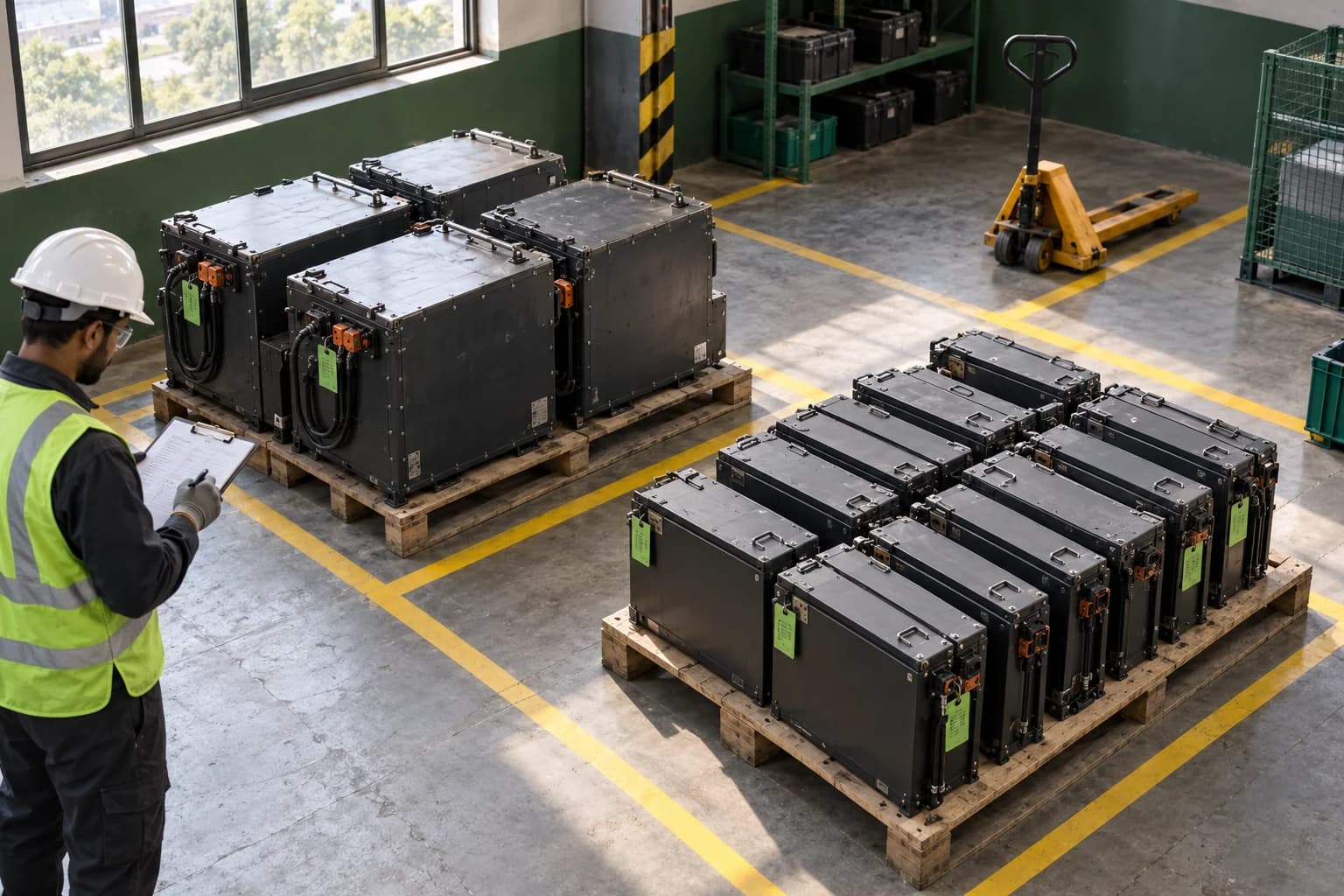
Packing affects safety in transit and speed at your gate. Our standard is terminals taped or capped, packs palletised and strapped no more than three high, and every lot sealed against a safety checklist before dispatch. If your receiving bay needs a particular pallet size, label position or stack height, add it.
What data should come with each pack?
Decide what you need at pack level, not just per truck. We record each pack's sticker, its chemistry, the voltage, capacity, brand and date from its label, a condition grade, and a weight with a photo of the scale reading. That data is available as a spreadsheet for any lot on request.
Pack-level data lets a recycler check a lot against the specification unit by unit, and trace any question back to the pickup it came from. Our piece on chain of custody walks through how those records are created.
Which documents travel with each lot?
List them, so a missing one is obvious. Ours are a lot manifest listing every sticker with the pack count and total weight as sealed, a GST invoice, and an e-way bill where the consignment requires one. Under Rule 138 of the CGST Rules, that applies when a registered person moves goods with a consignment value exceeding fifty thousand rupees.
Documents with every lot
- Lot manifest
- Every sticker, with the pack count and total weight as sealed
- Tax invoice
- A GST invoice for every lot
- E-way bill
- Where the consignment value exceeds fifty thousand rupees (CGST Rule 138)
- Pack-level data
- A spreadsheet of every pack in the lot, on request
How are price, delivery and payment set?
Write down the pricing basis, not just a figure: per kilogram, per chemistry, agreed before the first lot. Add the delivery point and receiving hours at your gate, your payment terms, and the lot size and cadence once they're agreed.
We agree lot sizes and a cadence only after the first lots reconcile. We'd rather commit to a number we can hit than a number that sounds good.
How is the weight settled?
Agree in advance whose weighbridge decides and what happens to a difference. We record your gate weight against our sealed weight for every lot and write the variance down rather than rounding it away. A small, explained variance is normal; an unexplained one is a question both sides can answer from the pack-level records. We walk through a full example in the consignment record, field by field.
A checklist to start from
Use it as the outline of the document, then add whatever your plant needs on top.
Specification checklist
- Chemistries accepted, one per lot
- Form: whole packs
- Condition: intact only, with any exceptions named
- Discharge: who does it, and where
- Packing standard
- Pack-level data required
- Documents with every lot
- Pricing basis, payment terms, delivery point and receiving hours
- Lot size and cadence
- Whose weighbridge decides, and how variance is handled
If you run registered recycling capacity and want to work through it with us, let's agree a specification. The full supply offer is on our page for recyclers.
Frequently asked questions
- What is a battery feedstock specification?
- A written agreement between a recycler and its supplier on what each lot contains and how it arrives: chemistry, form, condition, packing, data, documents, pricing basis and how weight is reconciled at the gate.
- Should LFP and NMC batteries be supplied in separate lots?
- Yes. They're different feedstock with different metals in their cathodes, so they're processed and priced differently. In our process every lot holds one chemistry.
- Who discharges collected EV battery packs?
- Agree it in the specification. CPCB's July 2026 guidelines expect collection centres to have a discharge facility for lithium-ion batteries, and say packs may have a state of charge below 30% of rated capacity in transport.
- Which documents should come with a lot of used batteries?
- At minimum a lot manifest listing every unit, a GST invoice, and an e-way bill where the consignment value requires one under Rule 138 of the CGST Rules.
We’d rather commit to a number we can hit than a number that sounds good.