
India's battery recyclers have a problem that sounds like it shouldn't exist. The country is putting electric vehicles on the road in enormous numbers, formal recycling plants exist to process their batteries, and yet those plants run short of material. The batteries are out there. They just don't arrive.
The gap sits upstream of the recycler, in collection: the unglamorous work of getting a used battery pack from wherever it came out of a vehicle to a plant that can process it properly, with a record of what it is and where it came from. This piece looks at that gap through the batteries that will define it: the lithium-ion packs in India's e-rickshaws, e-scooters and delivery fleets.
How many EV batteries are coming?
Electric vehicles have gone from a niche to a fleet. NITI Aayog reports that EV sales in India grew from 50,000 in 2016 to 2.08 million in 2024. In FY 2025-26 alone, 25,50,865 electric vehicles were sold, according to EVreporter's analysis of Vahan registration data.
Most of them are small. Electric two-wheelers made up 57.9% of those sales. Another 4,77,765 were e-rickshaws and 86,466 were e-carts, the low-speed three-wheelers that move people and goods across towns like those in western Uttar Pradesh and the NCR. Every one of them runs on a battery pack that will reach the end of its life.
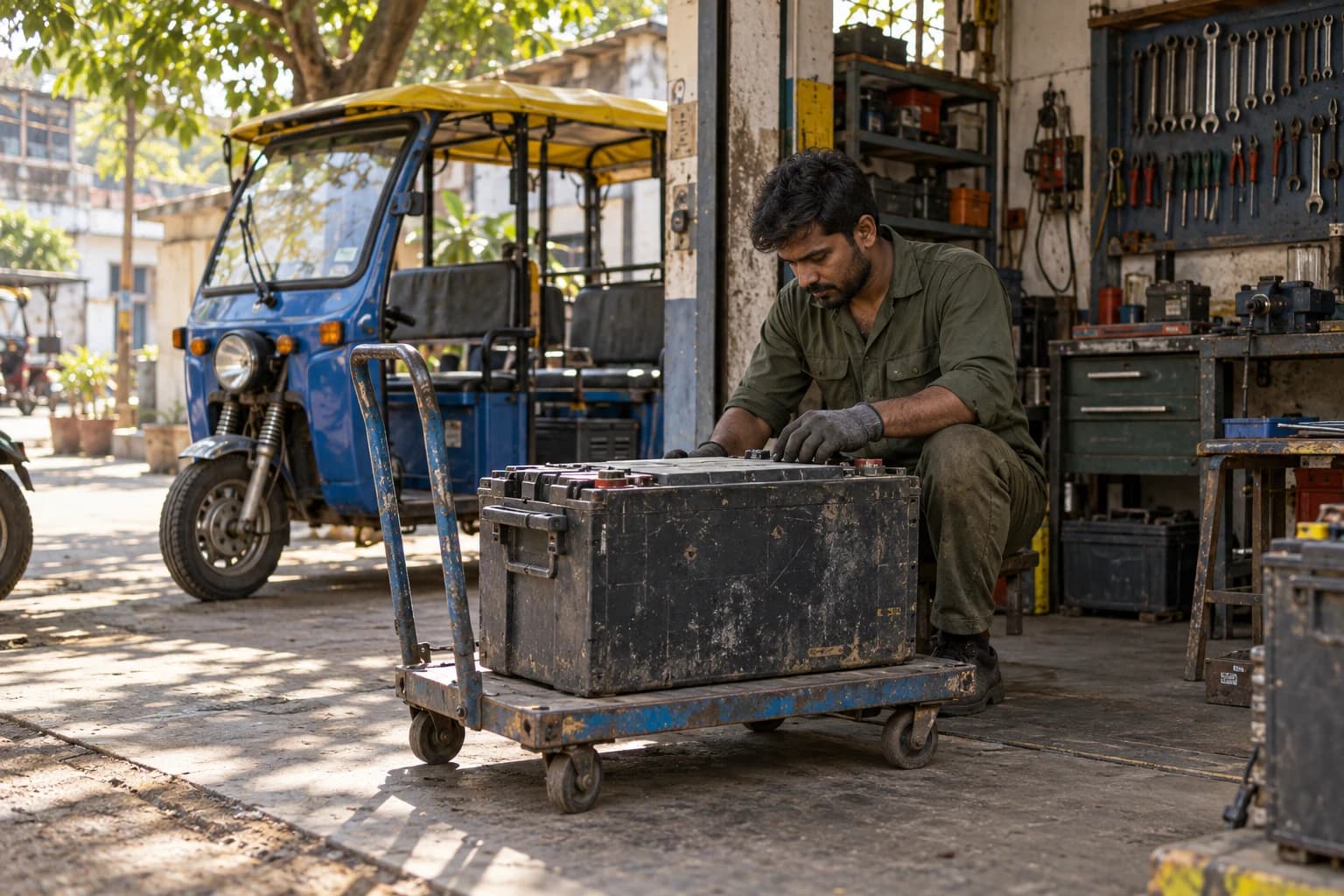
Each pack leaves its vehicle somewhere: at a dealer when the owner buys a replacement, at a service centre, at a charging yard, or at the depot of a fleet operator. Those are the starting points of a supply chain. They just rarely look like one.
Why lithium, and why now?
The e-rickshaw was built on lead-acid. WRI India notes that “e-rickshaws have mainly been operating on lead-acid batteries (LABs) since their formal introduction on Indian roads in 2010.” That is changing. In WRI's words, policy measures such as FAME II subsidies “have enabled the gradual adoption of LIB e-rickshaws.”
The reasons are practical. WRI notes that lithium-ion batteries reduce “the battery weight by almost three to four times as compared to LABs” and offer “lower charging time and more charge-discharge cycles.” The barrier has been price: around ₹16,600 per kWh for a lithium-ion pack against around ₹6,000 for lead-acid, by WRI's figures. As more fleets pay that premium, more of the packs coming back at end of life will be lithium.
That shift changes what collection has to handle. A lithium-ion pack is a sealed assembly of cells, electronics and connectors, valuable for what's inside it and hazardous when it's damaged. It needs a different kind of handling from the batteries the scrap trade grew up on.
Where does a used EV battery go today?
In most of the corridor, the first buyer is whoever turns up with cash. A pack comes out at a dealer, a workshop or a yard, a scrap buyer pays on the spot, and from there it moves through the informal trade. Sources are fragmented, each one produces a few packs at a time, and the person holding them wants to be paid today.
None of it leaves a record. Nobody writes down which pack came from where, what chemistry it was, what it weighed, or where it went. That is exactly what a formal recycler, and the rules that govern it, need.
Why do lithium-ion packs need a formal route?
Because of what's inside them. India's Ministry of Mines lists lithium, cobalt, nickel and graphite among the 30 minerals it considers critical for the country. A lithium-ion pack carries several of them. When a pack is broken open without proper process, part of that material is simply lost.
And because of what can go wrong. The US Environmental Protection Agency warns that “even used batteries can have enough energy to injure or start fires”, and that a lithium-ion battery that is “damaged or crushed in transport” creates “a fire hazard.” Informal dismantling runs without the controls a registered plant is required to have, which puts the people doing it, and everyone near them, at risk.
A formal route handles both: material reaches a plant that can recover it, and every pack is handled as the hazard it is from the moment it's collected.
What do the rules say about EV batteries?
The Battery Waste Management Rules, 2022 treat EV batteries as a category of their own: an electric vehicle battery is “any Battery specifically designed to provide traction to hybrid and electric vehicles for road transport.” Producers' collection and recycling targets are set by chemistry within each category, Li-ion included.
Collected waste batteries “shall be sent for recycling or refurbishing and shall not be sent for landfilling or incineration”, and entities involved in collection must hand waste batteries over to a registered refurbisher or recycler. We explain the rules in detail in What the Battery Waste Management Rules mean for producers, recyclers and collectors.
Why do formal recyclers run below capacity?
India's formal recyclers aren't short of plant. What they're short of is feedstock that arrives consistently, sorted to a specification, with documentation they can report against. Every serious recycler in the country can process more than it receives.
The informal trade wins on three things a formal system has historically struggled with: it pays cash on the spot, it is present everywhere packs come out, and it asks no questions. A formal recycler can't send a truck to every workshop for four packs. Someone has to aggregate small, scattered sources into loads worth a truck, at a price that competes with cash, without losing track of a single pack.
What does formal collection have to do differently?
Formal collection only works if it competes on the seller's terms while meeting the recycler's. On the seller's side that means rates quoted upfront, free pickup, same-day payment and a GST invoice. On the recycler's side it means sorted material, single-chemistry lots (LFP and NMC never mixed), damaged packs kept out, and records that hold up.
It also means handling lithium as the hazard it is: terminals taped or capped, swollen and damaged packs held in quarantine, and loads strapped and stacked to a checklist. How we sort by chemistry and condition is set out in LFP and NMC: why chemistry and condition decide everything.
And it means records created at the point of collection, not assembled afterwards. Every pack we collect is stickered and weighed individually, and that record travels with it to the recycler's weighbridge. The process is set out in A battery changes hands. Its record shouldn't disappear, and the whole chain on How it works.
Collection is infrastructure
It's tempting to think of battery recycling as a technology problem: better plants, better recovery rates. Those matter. But the bottleneck we see is the step before the plant: route density, sorting, documentation and a price that wins the pack away from cash on the spot.
That's the layer we're building, starting in one corridor (western Uttar Pradesh and the NCR) for reasons we set out in Why we start with one corridor. If you run registered recycling capacity and your constraint is feedstock, talk to us.
Frequently asked questions
- What batteries do Indian EVs use?
- E-rickshaws were built on lead-acid, but WRI India notes that subsidies such as FAME II have enabled the gradual adoption of lithium-ion e-rickshaws. Lithium-ion packs are lighter and last more charge cycles, at a higher upfront cost.
- Are used lithium-ion batteries dangerous?
- They can be. The US Environmental Protection Agency warns that even used batteries can have enough energy to injure or start fires, and that batteries damaged or crushed in transport create a fire hazard.
- Why are EV batteries worth recycling?
- They contain materials India treats as critical. The Ministry of Mines lists lithium, cobalt, nickel and graphite among the country's 30 critical minerals.
- Where should a used EV battery go?
- Under the Battery Waste Management Rules, 2022, waste batteries must go for recycling or refurbishment, and collection entities must hand them over to a registered refurbisher or recycler.
We’d rather commit to a number we can hit than a number that sounds good.
Start a conversation