
On this page
An EV battery doesn't fail all at once. It loses range until it no longer suits the vehicle, and then someone has to decide what happens to it: back into service in a less demanding job, or on to a recycler.
The Battery Waste Management Rules, 2022 give that decision a vocabulary. This piece uses it, with rule references, from the point of view of the EV makers, fleets and dealers who face the decision. It isn't legal or technical advice.
What is an electric vehicle battery under the rules?
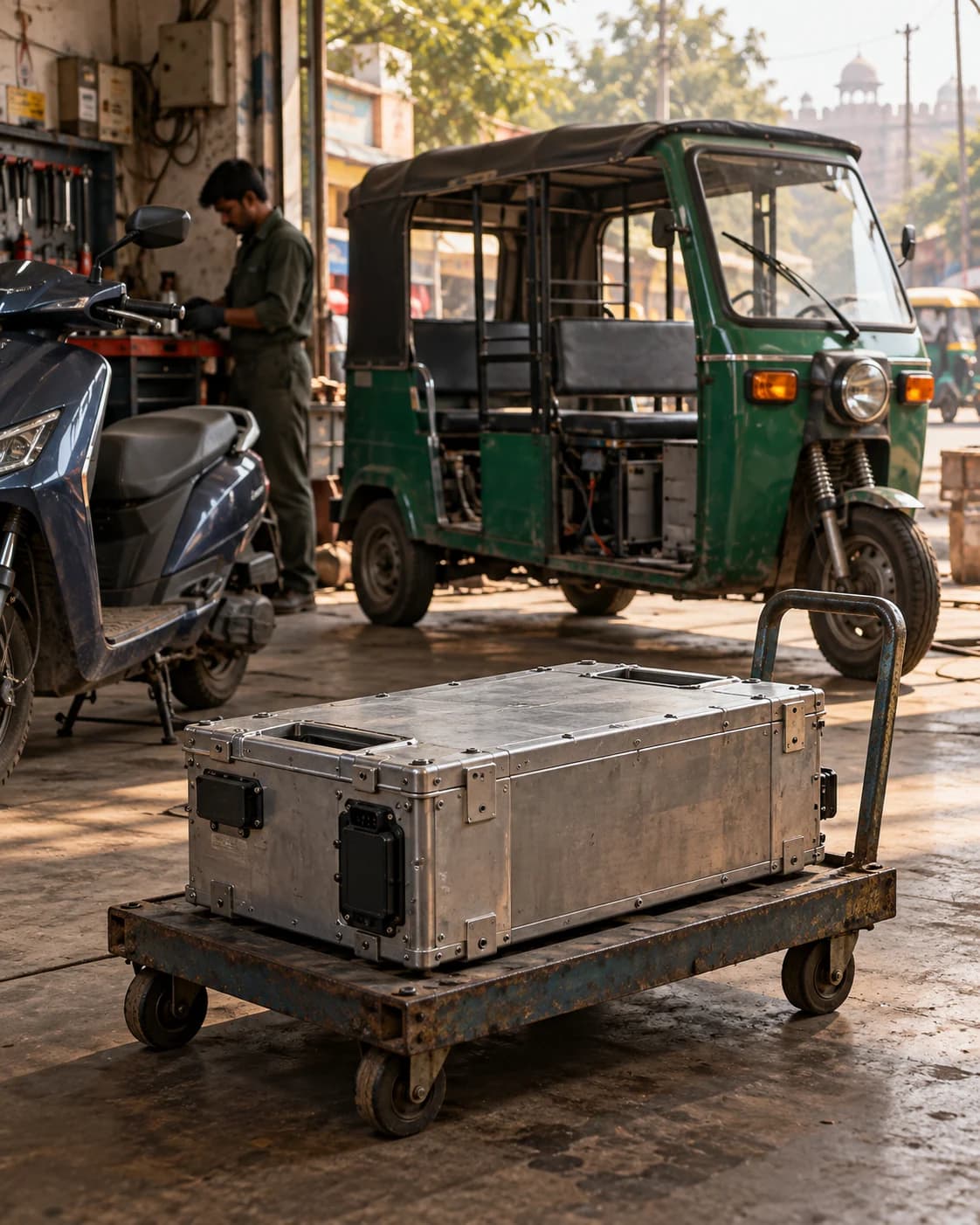
Rule 3 defines an electric vehicle battery as “any Battery specifically designed to provide traction to hybrid and electric vehicles for road transport.” The traction packs in e-rickshaws, e-scooters, e-loaders and electric cars all fall in this category, whatever their chemistry.
In India's e-rickshaw fleet, lithium is still the minority chemistry, so the lithium packs reaching end of life now are the start of the stream rather than its peak.
- e-rickshaws registered on Vahan by November 2024
- 18.1 lakh+
- of the e-rickshaw market on lithium-ion; about 90% on lead-acid
- ~10%
Used or end-of-life: what's the difference?
The rules separate the two. A used battery is one with “residual life and suitable for refurbishment”. An end-of-life battery has “completed its intended use and is not meant for refurbishment.”
Both are waste batteries under the rules, a wide term that also covers components, off-spec batteries and any battery “discarded by the user.” Once a pack leaves the vehicle for good, it's a waste battery, and the rules decide where it can go.
Three definitions (Rule 3)
- Used battery
- Has residual life and is suitable for refurbishment
- End-of-life battery
- Has completed its intended use and is not meant for refurbishment
- Waste battery
- Both of the above, plus components, off-spec batteries and anything discarded by the user
What is refurbishment?
Refurbishment means “repairing, re-conditioning, re-purposing of used Battery for its second life.” A pack that can no longer power a vehicle may still serve somewhere less demanding.
Refurbishers must register with their State Pollution Control Board, and a producer that sells refurbished batteries under its own brand carries EPR obligations for them like any other.
When does recycling make sense?
When a pack has completed its intended use and isn't meant for refurbishment, recycling recovers its materials instead. That work belongs to registered recyclers, and waste batteries collected under EPR must be sent for recycling or refurbishing, never to landfill or incineration.
The rules expect this to start soon for three-wheelers. A 2023 amendment sets collection targets for e-rickshaw and other three-wheeler EV batteries from 2026-27, at a minimum of 70% of the batteries placed on the market in 2021-22.
Typical battery life assumed by vehicle type
Years
| Two-wheelers | 4 years |
|---|---|
| Three-wheelers | 5 years |
| Cars | 8 years |
| Buses | 8 years |
Who decides which route a pack takes?
The rules set the routes, not a test. In practice the decision sits with whoever holds the pack and the people qualified to assess it: the EV maker or its service network, a fleet's maintenance team, a registered refurbisher.
Whichever route it takes, Rule 7 requires anyone collecting it to “hand over Waste Battery to registered refurbisher or recycler.” Under Rule 5, a consumer should give a waste battery to an entity engaged in collection, refurbishment or recycling, and keep it out of mixed and domestic waste.
Where it shouldn't end up
- Landfill
- Incineration
- Informal dismantling
The two registered routes
- Second life, through a registered refurbisher
- Material recovery, through a registered recycler
Where do we fit?
We collect end-of-life lithium-ion EV packs, LFP and NMC, and route them to CPCB-registered recyclers only. We don't dismantle them. Every pack is graded on condition at pickup, and swollen or damaged packs are held separately and never sealed into a lot.
So if a pack still has a second life in it, a registered refurbisher is its next stop. If it doesn't, we're built for that part of the chain. Fleets can read how collection works from their hubs, and EV makers how a take-back programme works.
What about damaged or swollen packs?
Treat them as their own case. Keep them apart from other batteries, in an open space, and tell your collector before pickup so the crew comes prepared. A damaged pack shouldn't travel inside a normal load: in our process it's recorded, quarantined, and never enters a lot.
Frequently asked questions
- What is the difference between a used and an end-of-life battery?
- Under the Battery Waste Management Rules, 2022, a used battery has residual life and is suitable for refurbishment; an end-of-life battery has completed its intended use and is not meant for refurbishment.
- Can an EV battery get a second life?
- Yes, if it has residual life. The rules define refurbishment as repairing, re-conditioning or re-purposing a used battery for its second life, and refurbishers must be registered.
- Where must an end-of-life EV battery go?
- To a registered refurbisher or recycler. Rule 7 requires entities involved in collection to hand waste batteries over to them, and batteries collected under EPR must not be landfilled or incinerated.
We’d rather commit to a number we can hit than a number that sounds good.