
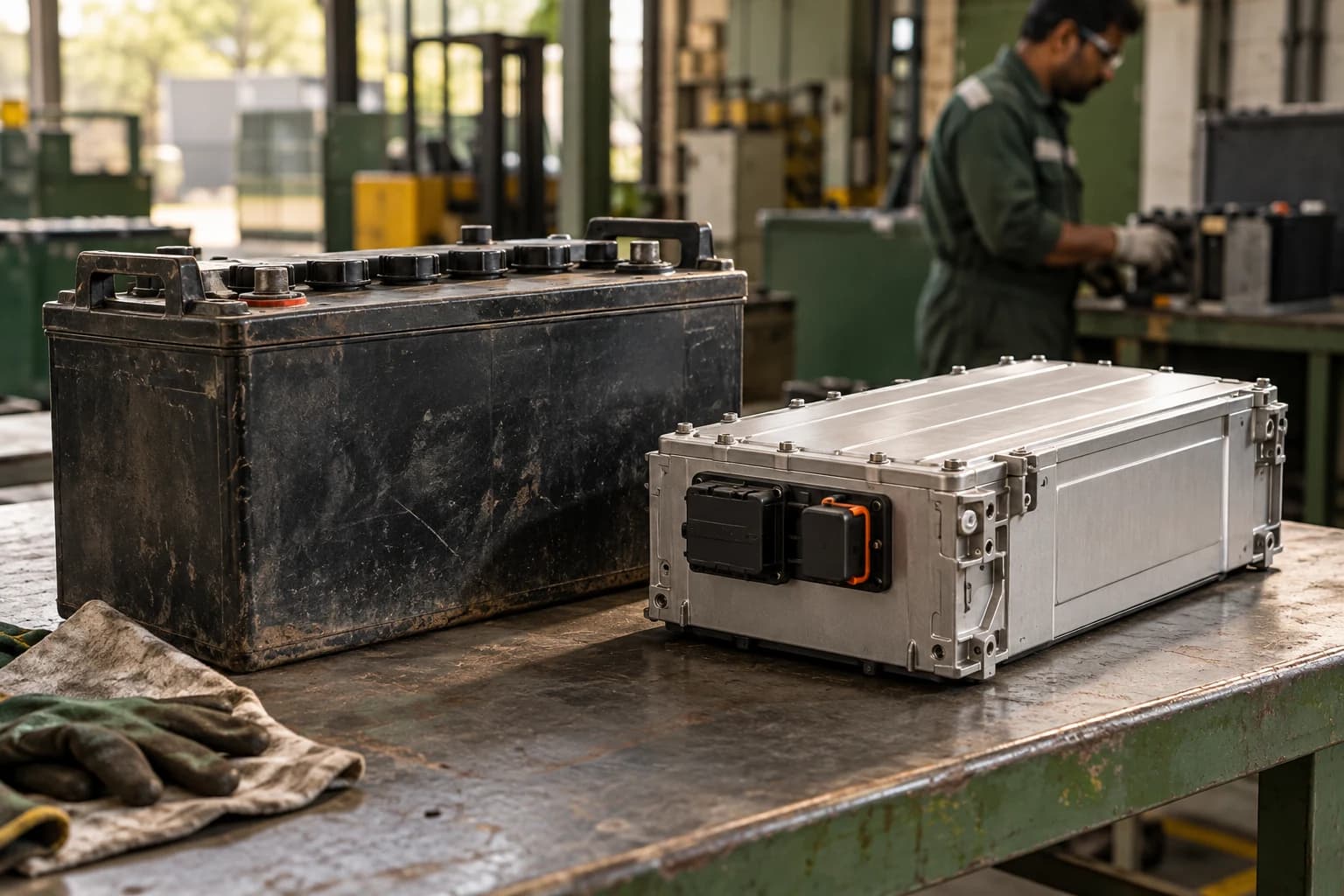
Every battery we collect is lithium-ion, but lithium-ion is a family, not a single material. We collect two members of it: lithium iron phosphate (LFP) and nickel manganese cobalt (NMC). In a sealed casing on a workshop floor they can look alike. To a recycler they're different feedstock.
That's why sorting comes before everything else in formal collection. This piece explains what separates the two chemistries, why they must never share a load, and why a pack's condition matters as much as what it's made of.
What's the difference between LFP and NMC?
The names describe the cathode, the part of each cell that defines the chemistry. An LFP cell's cathode is lithium iron phosphate. An NMC cell's cathode is a lithium oxide of nickel, manganese and cobalt. So an NMC pack carries nickel and cobalt, and an LFP pack carries neither.
Both share the rest of the lithium-ion recipe. The US Environmental Protection Agency describes lithium-ion batteries as “made of materials such as cobalt, graphite and lithium.” India's Ministry of Mines lists lithium, cobalt, nickel and graphite among the country's 30 critical minerals, which is why both chemistries are worth recovering properly.
Where do EV packs come from?
From every kind of electric vehicle on the corridor's roads: e-rickshaws and e-carts, e-scooters, e-loaders and delivery fleets. WRI India notes that subsidies have “enabled the gradual adoption of LIB e-rickshaws”, so the vehicle that used to mean lead-acid now increasingly means lithium too.
A pack's chemistry isn't something to guess from the vehicle it came out of. It's read from the pack's own label at pickup, along with its voltage, capacity, brand and date, and written onto that pack's record. A pack with no label is set aside until it's identified.
Why don't we collect lead-acid?
Because it's a different business. A lead-acid battery's value is its lead, recovered by smelting in a secondary lead plant, and it moves through channels of its own. We collect lithium-ion EV packs only, so a lead-acid battery never enters our yard, let alone a lot.
The Battery Waste Management Rules, 2022 apply to all of them alike, “regardless of chemistry”, and set producers' targets by chemistry: lead-acid, Li-ion and others each carry their own.
Why can't LFP and NMC be mixed?
Because recyclers buy them as different materials. A load that mixes chemistries is a problem the recycler has to solve before they can start: unloading, identifying and separating packs that should never have shared a truck, before the material can go where it belongs.
So we don't send one. Chemistry is recorded on each pack's own record at pickup, and every lot is single-chemistry by rule: a lot that mixes chemistries cannot be sealed. The lot code says which before anyone opens the truck: LFP for lithium iron phosphate, NMC for nickel manganese cobalt. How those records are built is covered in A battery changes hands.
Why does battery condition matter?
Not every pack arrives in the same state, and condition changes how it must be handled. Every pack is graded on condition at the door: intact, swollen, damaged, or with no label.
A swollen or damaged lithium pack is a different risk from an intact one. The US Environmental Protection Agency warns that “even used batteries can have enough energy to injure or start fires”, and that a battery “damaged or crushed in transport” creates “a fire hazard.” Grading condition at the door means the yard knows what it's receiving before the truck is unloaded.
What happens to swollen and damaged packs?
They go to a separate quarantine bay. They're recorded like everything else (sticker, weight, source), but they can never be sealed into a lot. That isn't a policy someone has to remember on a busy day; the records won't allow it.
Keeping damaged packs out of lots protects everyone downstream: the crew loading the truck, the driver, and the recycler receiving a consignment that's meant to match its specification.
The seal checklist
Before a lot leaves the yard it passes a safety checklist: terminals taped or capped, no leaking packs, a single chemistry, palletised and strapped no more than three high, and PPE worn by the crew. The lot is sealed only when every item is ticked. Taping terminals is the same precaution the EPA recommends “to prevent fires.”
The result is a consignment whose contents are known before it reaches the gate, which is what a recycler actually wants from a supplier. If that's what you buy against, see For recyclers.
Frequently asked questions
- Can LFP and NMC batteries be recycled together?
- They contain different materials, and recyclers buy them as different feedstock. Mixing them means sorting work before processing can start, which is why our lots are single-chemistry.
- Does an LFP battery contain cobalt?
- No. An LFP cell's cathode is lithium iron phosphate, with no nickel or cobalt. An NMC cell's cathode contains nickel, manganese and cobalt.
- What should happen to a swollen lithium-ion battery?
- It should be separated from intact packs and held in quarantine. In our process, swollen and damaged packs are recorded but can never be sealed into a lot.
- Do the Battery Waste Management Rules cover lithium-ion batteries?
- Yes. The rules apply to all batteries regardless of chemistry, and producers' targets are set by chemistry, Li-ion included, within each battery category.
We’d rather commit to a number we can hit than a number that sounds good.
Start a conversation