
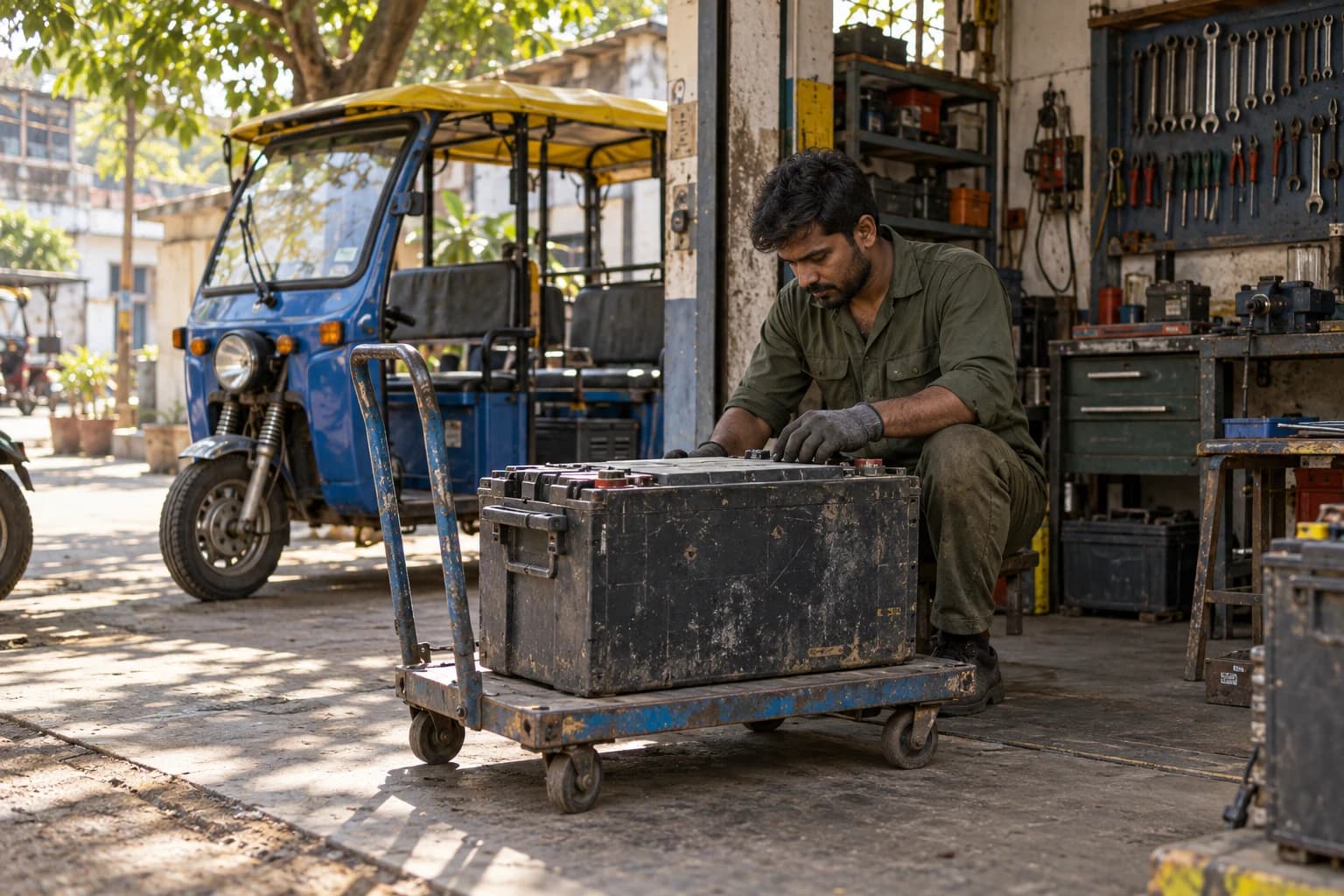
India's battery recyclers have a problem that sounds like it shouldn't exist. The country produces used batteries in enormous numbers, formal recycling plants exist to process them, and yet those plants run short of material. The batteries are out there. They just don't arrive.
The gap sits upstream of the recycler, in collection: the unglamorous work of getting a used battery from wherever it came out of a vehicle to a plant that can process it properly, with a record of what it is and where it came from. This piece looks at that gap through the battery that defines it in northern India: the one in the e-rickshaw.
How many e-rickshaw batteries reach end of life?
The e-rickshaw is now one of the most common vehicles on the roads of western Uttar Pradesh and the National Capital Region. In FY 2025-26 alone, 4,77,765 e-rickshaws and 86,466 e-carts were sold in India, according to EVreporter's analysis of Vahan registration data.
Most of that fleet runs on lead-acid. As WRI India puts it, “e-rickshaws have mainly been operating on lead-acid batteries (LABs) since their formal introduction on Indian roads in 2010”, and those batteries “typically need replacement every year.” A fleet that size, on batteries replaced that often, produces a large and constant stream of used batteries. Lithium iron phosphate (LFP) packs are joining that stream as operators switch.
Every one of those batteries leaves its vehicle somewhere: at a dealer when the owner buys a replacement, at a charging yard, at a service centre, or at the depot of a fleet operator. Those are the starting points of a supply chain. They just rarely look like one.
Where does a used e-rickshaw battery go today?
In most of the corridor, the first buyer is whoever turns up with cash. A battery comes out at a dealer or a yard, a scrap buyer pays on the spot, and from there it moves through the scrap trade. Sources are fragmented, each one produces a few batteries at a time, and the person holding them wants to be paid today.
Much of that material never reaches a formal recycler. WRI India, citing a NITI Aayog report, notes that “about 90% of these End of Life (EoL) batteries were recycled informally, which is both inefficient and unsafe.” Toxics Link's study of the lead-acid trade reached the same conclusion: “even after several years of legal framework being in place, majority of used batteries are estimated to reach the informal recycling sector.”
None of it leaves a record. Nobody writes down which battery came from where, what it weighed, or where it went. That is exactly what a formal recycler, and the rules that govern it, need.
What happens to batteries in the informal trade?
A lead-acid battery's value is its lead. In the informal trade, recovering it means breaking the case open and melting the plates down, usually without the controls a registered plant is required to run. Toxics Link found that “the entire process, from collection of the batteries, transportation, dismantling, smelting and disposal of the components, is not done in environmentally sound manner.”
The stakes are not abstract. The World Health Organization notes that “most global lead consumption is for the manufacture of lead-acid batteries for motor vehicles”, that “there is no level of exposure to lead that is known to be without harmful effects”, and that “exposure to lead-contaminated soil and dust resulting from battery recycling and mining has caused outbreaks of mass lead poisoning.”
Informal recycling also wastes material. Without proper processes, part of what a battery contains is simply lost: material a formal plant would have recovered.
Why do formal recyclers run below capacity?
India's formal recyclers aren't short of plant. What they're short of is feedstock that arrives consistently, sorted to a specification, with documentation they can report against. Every serious recycler in the country can process more than it receives.
The informal trade wins on three things a formal system has historically struggled with: it pays cash on the spot, it is present everywhere batteries come out, and it asks no questions. A formal recycler can't send a truck to every dealer for four batteries. Someone has to aggregate small, scattered sources into loads worth a truck, at a price that competes with cash, without losing the record along the way.
What does formal collection have to do differently?
Formal collection only works if it competes on the seller's terms while meeting the recycler's. In practice that means rates quoted upfront, free pickup, same-day payment and a GST invoice on the seller's side; and on the recycler's side, sorted material, single-chemistry loads and records that hold up.
It also means following the law on where batteries can go. Under the Battery Waste Management Rules, 2022, entities involved in collection must hand waste batteries over to a registered refurbisher or recycler. We explain the rules in detail in What the Battery Waste Management Rules mean for producers, recyclers and collectors.
And it means records created at the point of collection, not assembled afterwards. Every battery we collect is stickered and weighed individually, and that record travels with it to the recycler's weighbridge. The process is set out in A battery changes hands. Its record shouldn't disappear, and the whole chain on How it works.
Collection is infrastructure
It's tempting to think of battery recycling as a technology problem: better plants, better recovery rates. Those matter. But the bottleneck we see is the step before the plant: route density, sorting, documentation and a price that wins the battery away from cash on the spot.
That's the layer we're building, starting in one corridor (western Uttar Pradesh and the NCR) for reasons we set out in Why we start with one corridor. If you run registered recycling capacity and your constraint is feedstock, talk to us.
Frequently asked questions
- What batteries do e-rickshaws use?
- Mostly lead-acid. WRI India notes that e-rickshaws have mainly operated on lead-acid batteries since their formal introduction on Indian roads in 2010. Lithium iron phosphate (LFP) packs are increasingly used as operators switch.
- How often are e-rickshaw batteries replaced?
- According to WRI India, lead-acid e-rickshaw batteries typically need replacement every year, which is why the e-rickshaw fleet produces a large and constant stream of used batteries.
- Where should a used e-rickshaw battery go?
- Under the Battery Waste Management Rules, 2022, a consumer should give a waste battery to an entity engaged in collection, refurbishment or recycling, and collection entities must hand waste batteries over to a registered refurbisher or recycler.
- Why is informal battery recycling a problem?
- It typically lacks the controls a registered plant must run. Toxics Link found the informal process is not done in an environmentally sound manner, and the WHO notes there is no level of lead exposure known to be without harmful effects.
We’d rather commit to a number we can hit than a number that sounds good.
Start a conversation